
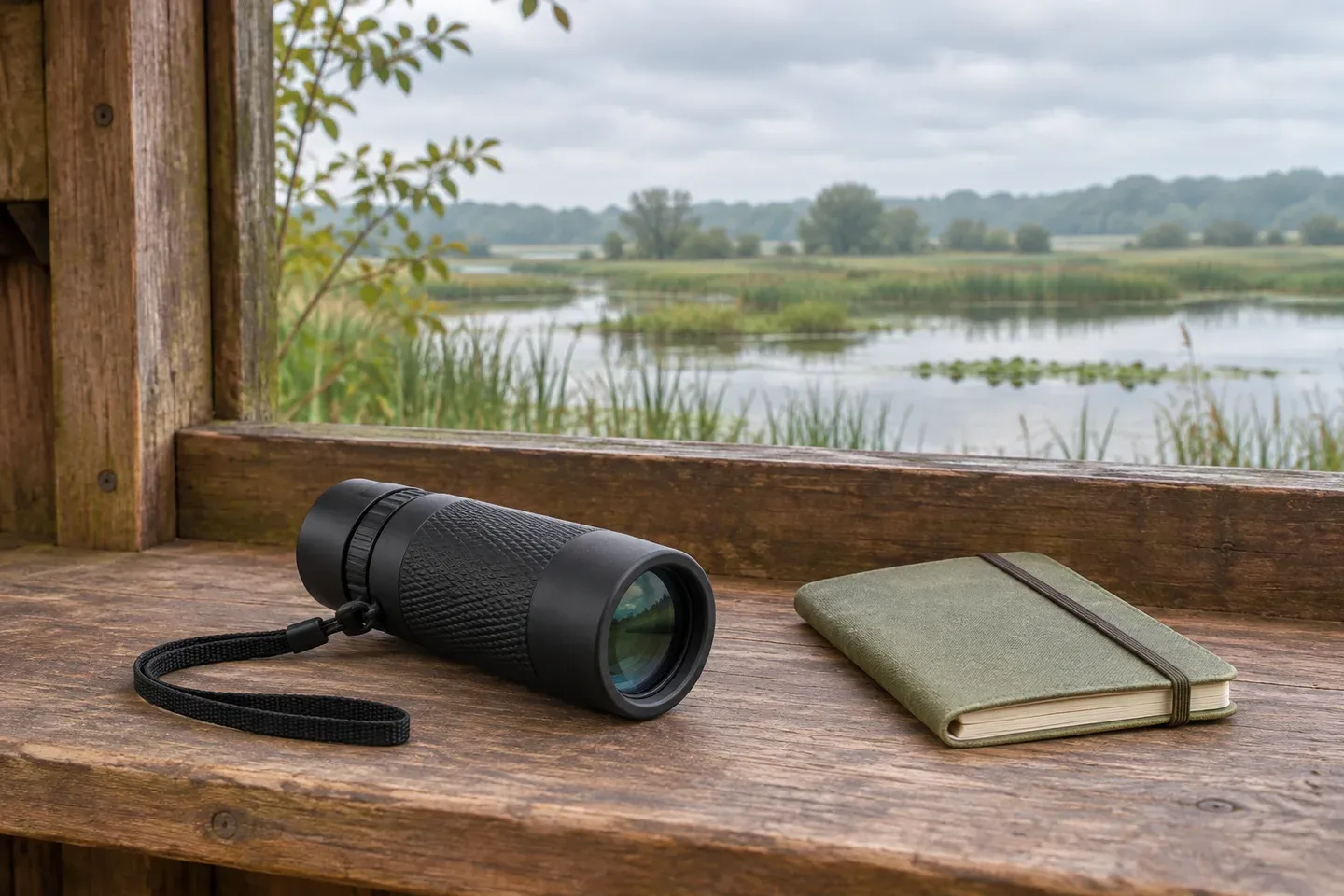
A monocular can be a useful companion for a walk when a pocketable optic matters. It uses one viewing barrel, leaving the other eye free, and can be quicker to pack than some two-barrel binoculars. The right choice still depends on what you want to see, where you will carry it, and whether you can hold it steady. A larger magnification number alone cannot tell you which optic will suit you.
This guide explains the specifications to compare before choosing a monocular for birdwatching. It does not rank products or substitute for trying an optic. For another perspective on equipment and technique, explore the Expert Binocular journal.
Start with your birdwatching setting
Think about a typical outing instead of an ideal specification sheet. Are you watching birds across a lake, following small birds among branches, or keeping an optic in a jacket for occasional sightings? An open shoreline, shaded woodland and a city park put different demands on field of view, light and carrying comfort.
Also consider how long you will observe. A compact monocular may suit short checks, while two-eyed binocular viewing can feel more natural for longer sessions. Personal comfort varies, so handle a candidate before deciding if possible. Check that the focus control is reachable with the hand you intend to use and that your grip feels secure.
Read the magnification and objective diameter
A description such as 8x20 identifies the magnification and the objective lens diameter in millimeters. The first number is the magnification; the second describes the front lens. Compare both alongside the stated dimensions and weight. A larger front lens can gather more light, but size and optical design also influence the finished instrument.
Higher magnification can make small details look larger, but hand movement is also more noticeable. It can be harder to locate a moving bird through a narrow view. Nikon discusses these tradeoffs in its guide to optical specifications. The guide concerns binoculars, but the practical relationship between magnification, stability and field of view is relevant when comparing monocular specifications too.
When comparing two models, do not infer the entire view from the magnification. Read each manufacturer’s actual field-of-view figure and test the handling for yourself.
Compare field of view and close focus
Field of view describes how much of a scene is visible. Manufacturers may express it as an angle or as a width at a stated distance. Compare like units at the same reference distance; a wider view can make it easier to find a bird in a tree or follow movement between perches. It does not guarantee that one optical system will feel right to every viewer.
Close focusing distance matters if you also want to observe nearby butterflies, plants or details on a feeder. The specification tells you the nearest distance at which the optic can focus; it is not a measure of how large the subject appears. ZEISS describes the close-range uses of its monocular range. Check the exact model’s data rather than assuming all monoculars focus equally close.
Check eye relief and the eyecup
If you wear glasses, look for the manufacturer’s eye-relief specification and see whether the eyecup adjusts to suit you. Eye relief is the distance from the eyepiece lens to the position where the full view is formed. Nikon’s explanation of eye relief describes why longer relief can help eyeglass wearers see the whole field.
Fit is individual: frame shape and how glasses sit on your face can change the usable distance. Try the eyecup positions with the glasses you actually wear and look for a complete, comfortable view. Avoid pressing the optic hard against lenses or skin. Follow the maker’s instructions for adjustment and care.
Plan for weather, carrying and cleaning
Read the manufacturer’s precise weather rating. Splash resistance and a specified waterproof rating are not interchangeable, and neither should be interpreted as permission to submerge an optic beyond its stated limits. After a damp outing, follow the product manual for drying and storage. Avoid sealing a wet optic in a case.
Check whether a strap, protective caps and case are included, and whether you can reach the optic without dropping it. A secure strap and a case that fits your bag can matter more than a small difference in stated weight. Use only cleaning tools and methods recommended for the actual lens coating; brush away loose grit before wiping when the manufacturer instructs you to do so.
A simple comparison checklist
- Match the size and carrying method to a real outing.
- Compare magnification with field of view and the steadiness of your grip.
- Check close focus if you watch nearby subjects.
- Try eye relief and eyecup settings with your glasses, if worn.
- Read the specific weather rating and care instructions.
- Compare the total kit, including case, caps and strap.
Frequently asked questions
Is a monocular better than binoculars for birdwatching?
Neither is universally better. A monocular may be convenient to carry; binoculars allow viewing with both eyes. Choose according to the length of your outings and what feels comfortable.
Does higher magnification always show more detail?
Not necessarily. A shaky view and the difficulty of finding a moving subject can offset the benefit of a larger image. Compare magnification with field of view and handling.
Can glasses wearers use a monocular?
Many can, but the useful eye relief and eyecup adjustment vary by model and by the glasses. Check the specifications and try the combination before deciding.
Cover: AI-generated editorial illustration of an unbranded monocular; not a product photograph.