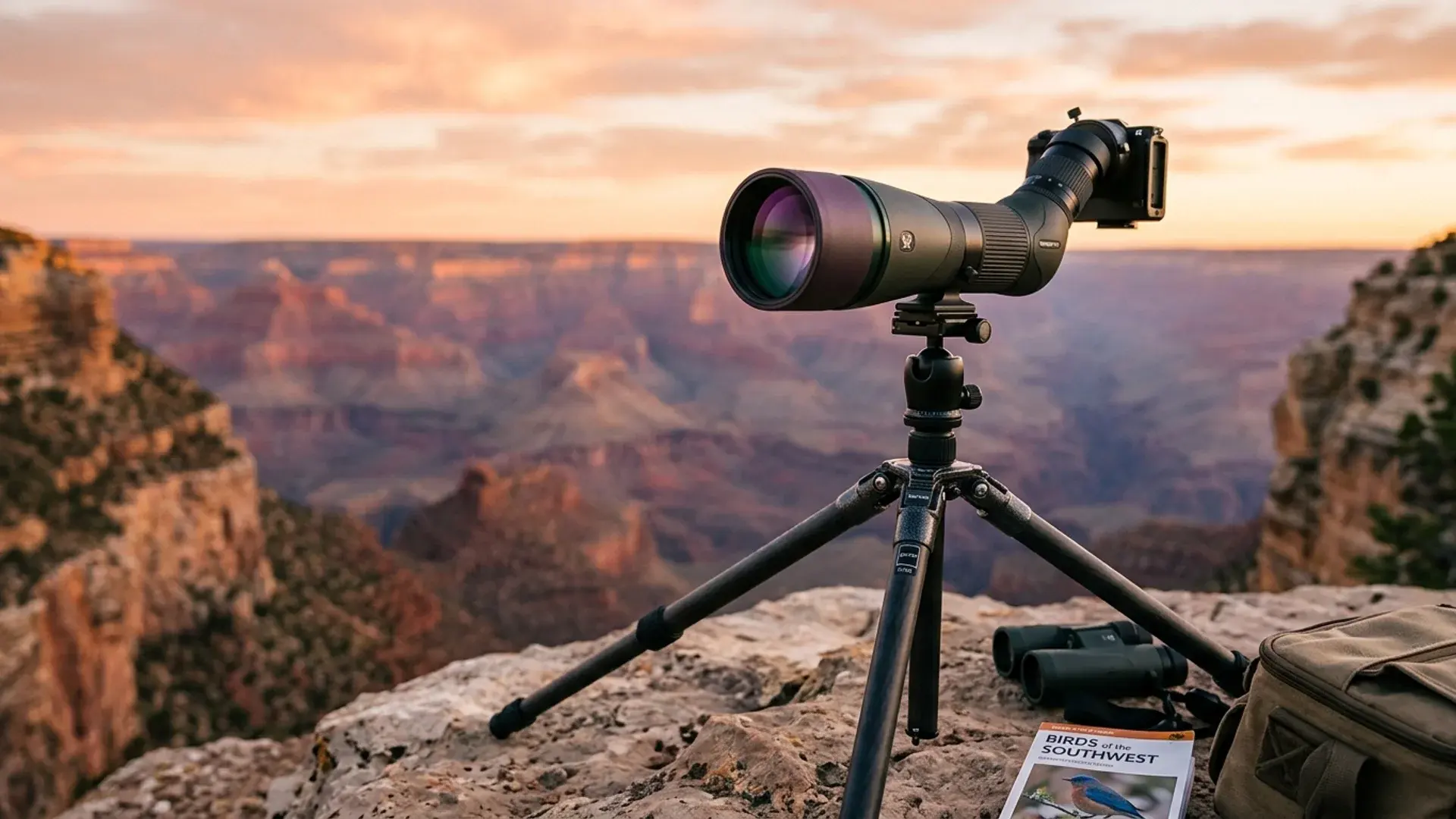
A lens shade is a small part of a spotting scope that is easy to overlook. It extends around the front objective lens and can help block stray light from entering at an angle. Depending on the scope, the shade may be fixed, retractable or supplied as a separate accessory.
Before adjusting or adding a shade, identify your scope and consult its instructions. This guide explains what to check and how to care for the assembly; it does not make a shade a protective filter or a substitute for safe optical use.
Find the front shade
The objective is the large lens at the front of the scope. Look for a surrounding tube that projects beyond the glass. Some models have a fixed extension, while others have a sleeve that slides forward. A removable accessory may attach in a different way.
Celestron explains lens shades and dew shields as extensions that help block distracting angled light. It notes that certain scopes have retractable shades. The mechanism and travel distance are model-specific, so use the manual rather than assuming every front ring should move.
With the scope supported securely, identify the part before handling it. If it does not move easily, stop. Do not twist, pull or remove a component unless the manufacturer says to do so. A ring near the objective may have another purpose.
Understand what a shade can do
A shade can reduce the amount of stray light reaching the objective from outside the intended view. This may help with flare or loss of contrast in bright conditions, although the result depends on the direction of light and the optical system.
A shade can also provide some physical shelter around the front lens. It is not a guarantee against rain, dust, impact or condensation. Celestron describes its role as a dew shield under certain conditions, but weather and equipment differ. Follow the scope maker’s environmental limits and keep the lens cap available when the instrument is not in use.
Never look at the Sun through a spotting scope without a properly specified solar filter and appropriate expert guidance. A lens shade does not make solar viewing safe. Even brief direct viewing through optics can cause permanent eye injury.
Check a retractable mechanism
If your manual describes a retractable shade, extend it gently as directed. Support the scope body and avoid touching the objective glass. Check that the shade stays in its intended position and does not wobble excessively.
Do not use force if the sleeve sticks. Dust, impact or a damaged mechanism may require attention by the manufacturer or an authorized service provider. Avoid adding household lubricants, which could migrate onto optical surfaces or seals.
Before packing, retract the shade only as the manual directs and install the lens cap. Some caps fit over the shade in one position but not another. If the cap requires force, confirm that the shade and cap are aligned correctly.
Consider a replacement or accessory
When a scope uses a separate shade, check the exact model and part number. Measure only as the manufacturer directs: the outside diameter of the tube, the objective lens diameter and a threaded accessory size can be different measurements. A close-looking diameter alone does not establish compatibility.
Check how the part attaches and whether it interferes with an existing cap, protective cover or case. An accessory that blocks the field of view, rubs a moving part or prevents the cap from fitting is not a suitable match. Ask the manufacturer or a knowledgeable dealer if compatibility is unclear.
Do not attach a heavy or improvised shade that could shift the scope on its support. If you add an approved accessory, check the balance and tripod mounting instructions before leaving the setup unattended.
Clean and store with care
Use the scope manufacturer’s lens-care procedure. Remove loose debris from the exterior in the recommended way before wiping, and use only approved materials on the glass. A dusty shade is not a reason to rub the objective with a sleeve or paper towel.
After a damp outing, follow the maker’s drying and storage instructions. Allow the equipment to dry in a suitable environment, and do not trap moisture inside a closed case. Inspect the shade, caps and case before the next trip.
Keep the scope’s model and accessory part numbers with its documents. That makes it easier to confirm a replacement without guessing from appearance.
Explore spotting scopes and optical equipment at Expert Binocular and verify the instructions for the exact product before choosing an accessory.
Frequently asked questions
Is a lens shade a solar filter?
No. A shade blocks some stray light; it does not make it safe to look at the Sun through a scope.
Should every lens shade slide forward?
No. Shades may be fixed, retractable or separate. Check your scope’s manual and do not force a part that is not designed to move.
Does a shade prevent all condensation?
No. Its effect depends on conditions and design. Follow the manufacturer’s care and storage guidance after damp use.