
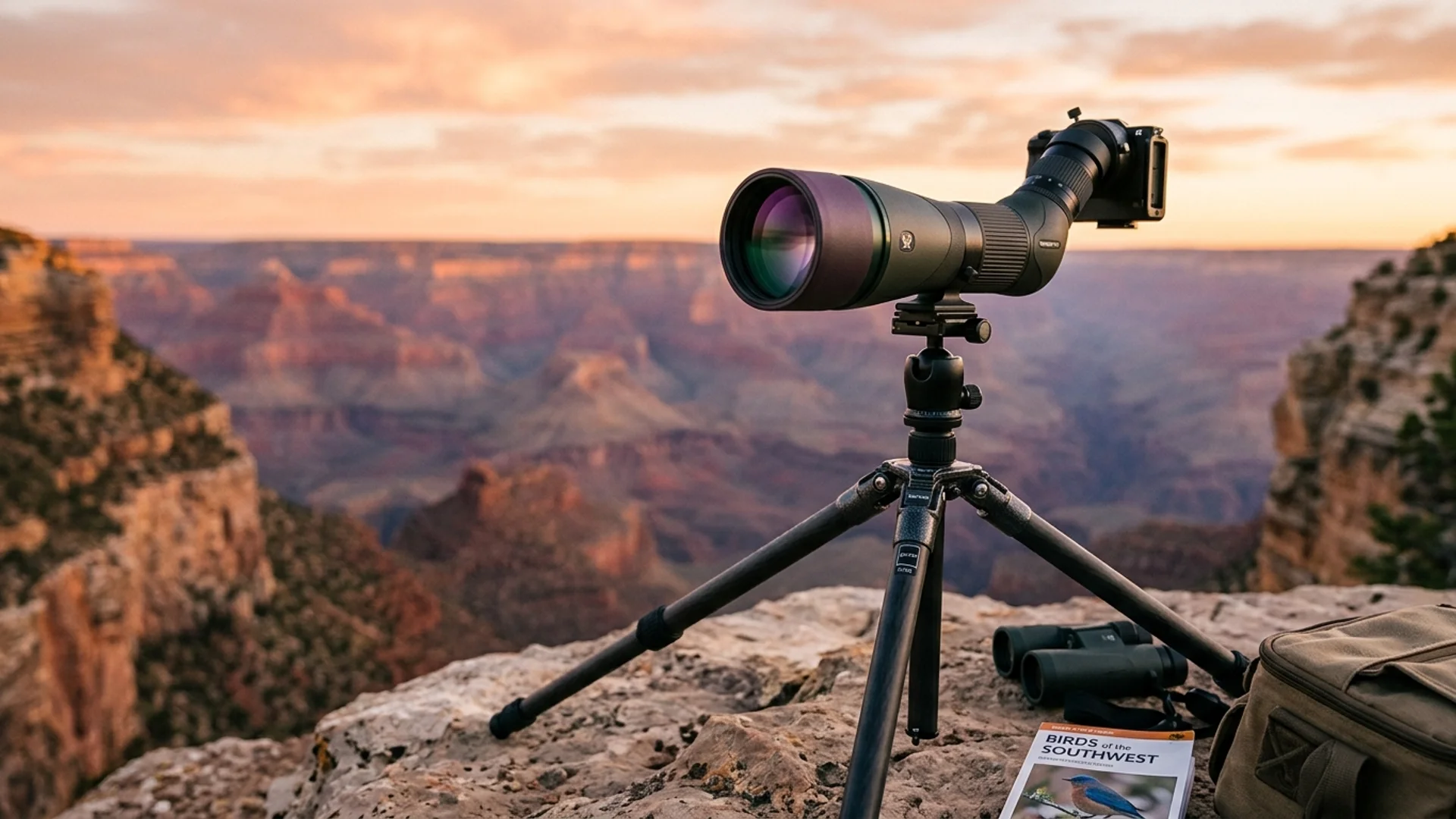
You can see birds on the far side of a lake, but you want a closer look at their markings. A spotting scope can become part of that outing. Choosing one, however, means choosing a complete viewing setup: the scope, eyepiece, support, and the weight you will carry.
Start by describing how you watch birds. A short walk to a hide and an all-day mountain trail place different demands on your equipment. This guide gives you a practical order for comparing spotting scopes for birdwatching, without choosing according to the largest magnification number.
Decide where the scope will spend its time
Write down your most common location, how far you walk, and whether you usually watch alone or with other people. Then set a budget for the complete kit.
For example, your brief might be: “I walk to a lakeside viewpoint, stay for an hour, and sometimes share the scope.” Another might be: “I carry all my equipment on a long trail and only stop occasionally.”
Keep that brief beside your shortlist. It will help you reject attractive features that do not serve your usual outing.
Choose an angled or straight body
A straight scope places the eyepiece along the body's viewing direction. Nikon describes this arrangement as straightforward to aim at a subject. An angled scope can be comfortable for upward viewing and can let you use a lower tripod position. It can also make sharing between people of different heights easier. Nikon's guide to straight and angled fieldscopes
| Your viewing routine | Body style worth trying |
|---|---|
| You prefer aiming directly along the scope | Straight |
| You often look above your position | Angled |
| You share with viewers of different heights | Angled |
| You have a particular hide or window to work around | Try both in a comparable position |
Treat these as prompts for trying equipment. Neither design automatically offers better optical quality.
Balance objective size with carrying weight
The objective is the large front lens. Its diameter is one part of the trade-off between light gathering and portability. Kowa's guide explains why a larger objective can be useful in lower light, while also increasing the size and weight of the setup. Kowa's objective-size guide
Compare the complete weight, including the eyepiece, rather than a body-only figure. Then add the tripod, head, cover, and anything else you plan to carry.
Do not assume the largest scope will be the most useful one. A scope that feels manageable when you leave home is more likely to come along on your next walk.
Check the eyepiece and optical specifications
Before buying, establish whether the advertised package includes an eyepiece. Some systems use separate components. If you choose a separate eyepiece, verify that it is compatible with that exact scope body.
Compare the zoom range, field of view, eye relief, and the optical features actually listed for the model. Kowa's buying guide highlights field of view, focusing, and optical quality as considerations alongside magnification. Kowa's spotting-scope buying guide
For your shortlist, write down what each package includes. “Scope body” and “scope kit” should lead to different questions about the remaining purchase.
Plan the support before buying
A compatible tripod and head are part of the setup, rather than an afterthought. ZEISS offers birding tripod kits designed around stability and portability, with specific mounting arrangements. Those details illustrate why you should check the connection between your scope, plate, head, and tripod. ZEISS tripod-kit specifications
Ask four questions:
- Does the head and plate fit the scope's mounting arrangement?
- Is the rated load suitable for the equipment you will attach?
- Does the viewing height work for your chosen body style?
- Can you comfortably carry and set up the complete kit?
Avoid assuming that two products will fit together because both mention a common mounting system. Confirm the exact combination.
Compare your shortlist as complete kits
Make one comparison sheet for each candidate. Include the body style, objective diameter, eyepiece, complete weight, weather-protection specification, support requirements, and total cost.
Then return to your original outing brief. Choose the setup that answers it with the fewest compromises you will notice each time you go birdwatching.
Browse spotting scopes at Expert Binocular and explore optical accessories. If you need help checking a scope-and-eyepiece combination, contact our team.
Frequently Asked Questions
Is an angled spotting scope better for birdwatching?
It can be convenient for upward viewing and sharing. A straight scope may feel more natural to aim. The better choice depends on your usual position and routine.
Should I buy the largest objective lens I can afford?
Not automatically. Compare its benefits with the size and weight of the entire kit, especially if you walk a long way.
Is the eyepiece always included?
No. Check the package contents and confirm compatibility if the body and eyepiece are sold separately.
What should I budget for besides the scope?
Allow for any required eyepiece, compatible tripod and head, mounting plate, and protection you need for your outings.