
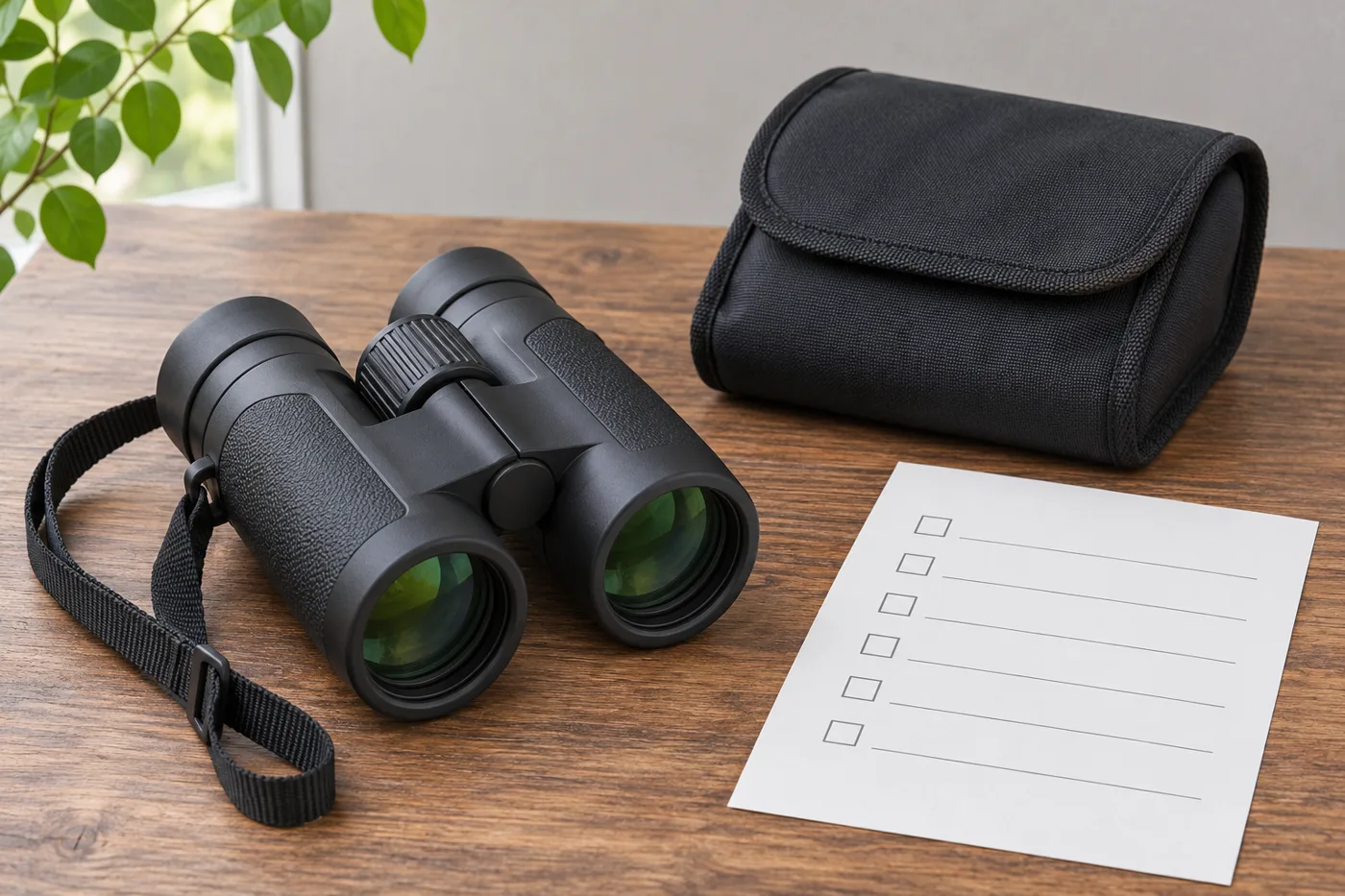
Used Binoculars: A Practical Inspection Checklist
A used pair of binoculars can be worth considering when you know what you are buying and can inspect it carefully. Its appearance alone does not reveal the condition of its optics or internal alignment, and a brief look cannot guarantee how it will perform later. Use this checklist to organize questions for the seller and decide whether a qualified inspection is appropriate.
Always follow the maker’s instructions for the exact instrument. Do not point binoculars at the sun or view the sun through them: Nikon warns that doing so can cause serious eye injury. Choose a safe, distant subject away from the sun for any permitted viewing check.
Confirm the identity and specifications
Start with the manufacturer, model name and the numbers marked on the binoculars. An 8x42 marking, for example, describes nominal magnification and objective diameter; it is not a measure of overall quality. Ask the seller for the exact model and any supplied documentation, and compare those details with the manufacturer’s information for that version.
Check the listed field of view, eye relief and close-focus distance if those matter for your intended use. Specifications and included accessories can change between versions. Our objective lens size guide explains the second number in a typical marking. If a specification is missing, avoid filling in the gap with a figure from a similarly named model.
Ask about history and conditions
Ask how the binoculars were stored, whether they have been dropped or serviced, and whether the seller knows of any issues. These answers are useful context rather than proof of condition. Check what accessories are actually included, such as eyecups, caps, strap, case and any adapter. Confirm whether those parts fit securely and match the instrument.
Inspect in a clean, well-lit place. Look over the housing and hinge for cracks, deformation, loose fittings or damage around the strap anchors. Normal cosmetic wear can be separate from a functional fault, but significant impact marks deserve careful questions. Nikon notes that shocks can affect the optical axis, so a professional check is sensible after a known hard impact.
Inspect the lenses without touching them
Look at the external glass from several angles for obvious scratches, chips, residue or signs of moisture. Do not shine a strong light into anyone’s eyes, and avoid touching the glass or rubbing dust across it. A mark seen at one angle may be on the surface, while a concern inside the instrument needs a qualified assessment. Photographs can help document what you saw but may not reveal all defects.
Do not attempt to open the barrels or remove eyepieces. Internal servicing and optical alignment require appropriate equipment and expertise. If the seller offers to clean the lenses, ask about the method and consult the maker’s care directions. Our lens cleaning guide provides a general starting point, subject to the instrument’s own instructions.
Try the controls gently
If the seller permits, move the hinge through its normal range and check that it can be set comfortably for your eye spacing. Try the focusing wheel and diopter adjustment gently, without forcing any control past its stop. Some binoculars focus centrally; others focus each eyepiece separately. Nikon describes these as distinct arrangements, so use the method intended for the model.
Check eyecups for damage and confirm that their positions can be adjusted as designed. If you wear glasses, try the binoculars with your glasses on and the eyecups set according to the manual. Comfort and the visible field depend on the instrument and the individual. A quick test is useful, but it does not replace a longer comparison in your normal conditions.
Look through both barrels
In suitable light, focus on a safe stationary subject at a comfortable distance. Adjust the hinge and focus according to the manual, then check whether you can obtain one comfortable view without persistent double images or eye strain. Test at more than one distance if the seller allows. Fatigue, incorrect setup or a mismatch with your eyesight can complicate interpretation; a problem does not identify its cause by itself.
Persistent double images or an inability to focus deserve an expert inspection. Do not try to adjust internal screws based on an online shortcut. Optical alignment is a service task, and altering it without the proper procedure may make the instrument worse.
Clarify what you cannot verify
A label such as waterproof does not prove that an older instrument still seals as originally designed. Do not submerge binoculars as a home test. Ask for the model’s actual specifications and service history, and consult the maker or an authorized service provider about any uncertainty. Also confirm the seller’s terms before purchasing; this guide makes no promise about a particular listing.
If remote buying prevents an inspection, request clear photographs of both ends, the controls and any disclosed marks. Ask specific questions and decide which unanswered points matter to you. A careful checklist cannot remove all uncertainty, but it can make your decision more informed.
Frequently asked questions
Do surface scratches prove the binoculars are unusable?
Not necessarily. Their location and effect vary. Have a qualified person assess any damage you cannot evaluate.
Can I test waterproofing in a sink?
Do not submerge the instrument. Ask the manufacturer or an authorized service provider how the model should be assessed.
What if the image remains double after setup?
Stop forcing adjustments and seek a qualified optical inspection. Setup and alignment are different questions.
Sources: Nikon: Binocular precautions and Nikon: Focus adjustment.
Featured image: AI-generated editorial illustration of generic binoculars.