
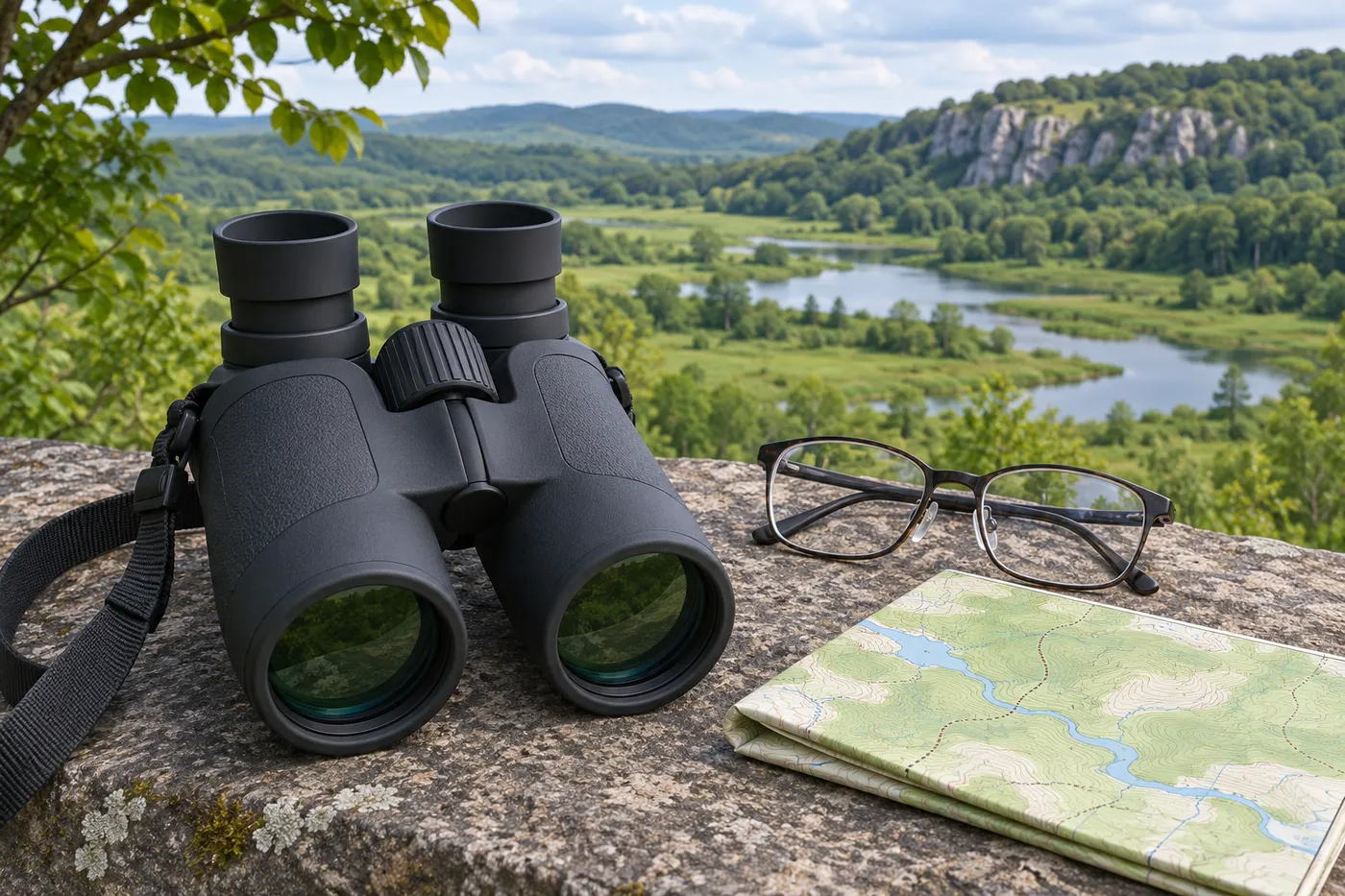
Binocular eyecups help position your eyes behind the eyepieces, but their best setting depends on your binoculars and whether you wear glasses. A few careful adjustments can make it easier to see the full field comfortably. This guide explains a general approach; use the manual for your exact model whenever its directions differ.
Identify the eyecup design
Look at the rubber or adjustable parts around the eyepieces, the lenses closest to your eyes. Some eyecups twist through several positions, while others fold or have a fixed shape. Check the instructions before moving them. Do not pull, twist beyond a stop or attempt to remove a part unless the maker specifically says that it is removable.
On the ZEISS Terra ED, for example, the manual describes four click-stop positions. That is a model-specific design, not a specification for every binocular. Your instrument may have a different adjustment range or mechanism.
Work over a soft surface and keep the strap secure while setting up. If a cup feels gritty, stiff, cracked or loose, stop and consult the manufacturer or a qualified service provider rather than forcing it.
Start with or without glasses
If you observe without glasses, try the eyecups extended as recommended for your model. If you wear glasses while observing, the glasses hold your eyes farther from the eyepieces, so many adjustable eyecups are set lower. The Terra ED manual, for example, tells glasses wearers to use its lowest click stop. Follow the instructions for your own binoculars and glasses.
Raise the binoculars naturally and look at a distant, stationary scene. You should be able to see a single comfortable circular image when the hinge and focus are also set for you. Do not press the binoculars hard against your glasses; protect both the lenses and the eyecups from scratches.
If the image has dark edges or seems difficult to see in full, lower the binoculars and adjust one setting at a time. The cause is not always the eyecups: the hinge, eye position and focus can also affect the view.
Adjust the hinge for your eyes
The hinge changes the distance between the two optical barrels. Looking through both sides, move the barrels gently until the two images merge into one circle. Do not force the hinge past its normal travel. Keep the eyecup positions consistent while you make this adjustment so you can tell what changed.
Next, focus on a stationary subject using the process in your model's manual. Many binoculars have a center focus wheel and a separate diopter adjustment, but the controls and sequence differ. Once set, make a note of the diopter position if you share the instrument with another observer.
For a closer look at this step, read our binocular eye spacing guide. The eyecups and hinge do different jobs, so it is useful to set each deliberately.
Try intermediate positions
If your binoculars have intermediate eyecup stops, try them one at a time. Bring the binoculars to your eyes gently, look at the same subject and note whether you can see the edge of the field without strain. A setting that works for one person may not be the most comfortable for another.
If you wear glasses, the shape and position of the frames can also affect viewing distance. Do not alter your glasses or force contact with the binocular. If you cannot obtain a comfortable view, ask an optics specialist to help check the fit and whether the model offers suitable eye relief for your needs.
Eye relief is a specification describing the viewing distance associated with the eyepiece. Compare the manufacturer's stated value when shopping, but treat it as one part of fit rather than a guarantee of comfort with every pair of glasses.
Recheck after sharing or packing
Eyecups can move while binoculars are carried in a case or passed to another observer. Before the next use, check that both sides are in their intended positions and that any caps fit without forcing the cups. Keep a simple note of your preferred positions if your model has several clicks.
After a damp or dusty outing, follow the instrument maker's care instructions. Remove loose debris as directed and use only cleaning materials approved for the optical surfaces. Do not assume a cleaning method for eyeglasses is automatically appropriate for a particular binocular coating.
If an eyecup no longer holds its setting or an optical surface appears damaged, contact the manufacturer or a qualified service provider. A comfortable, repeatable setup begins with a properly functioning instrument and the instructions for its exact model.
Cover: AI-generated editorial illustration of generic binoculars and eyeglasses.