
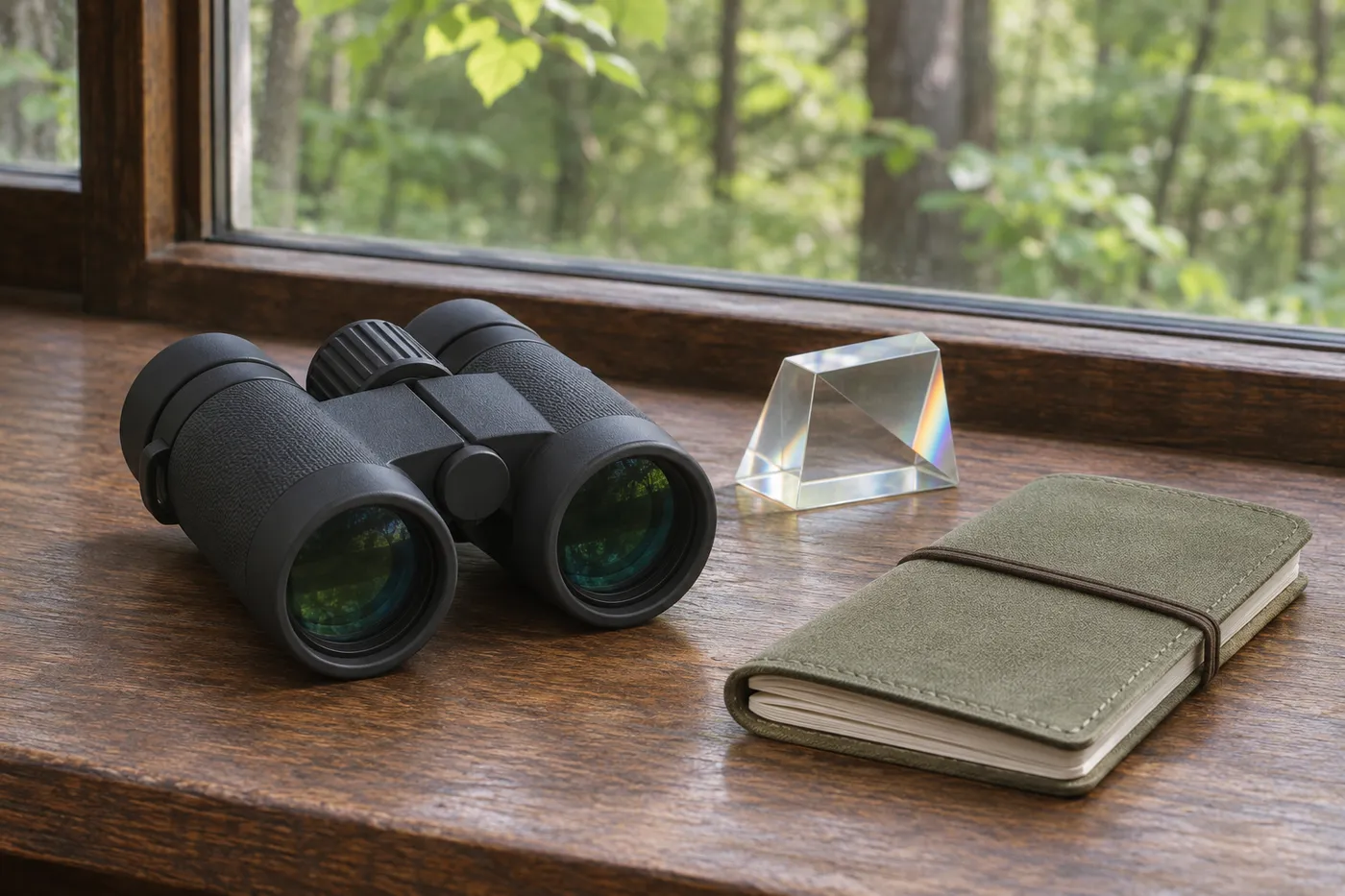
ED glass appears in the specifications of many binoculars, but the label alone does not tell you whether a particular pair fits your eyes or the way you observe. Understanding what the letters mean can help you compare descriptions without treating a single optical material as a complete quality rating.
ED stands for extra-low dispersion. In an optical design, this glass can help reduce chromatic aberration: color fringing caused when different wavelengths do not focus at the same point. How noticeable that fringing is depends on the complete optical system and viewing conditions.
What color fringing looks like
Imagine looking at a dark branch against a bright sky. A colored edge may appear along a high-contrast boundary. That is one situation in which chromatic aberration can be easier to notice, although other optical effects or reflections can also affect a view.
Nikon’s explanation of binocular aberrations describes how different wavelengths can have different focal lengths and how ED glass combined with other elements can reduce residual color error. Celestron’s introduction to ED glass discusses color fringing and high-contrast subjects.
These explanations describe an optical principle. They do not establish that every ED binocular will have the same correction, or that fringing will disappear for every viewer in every situation.
Glass is part of an optical design
A binocular contains multiple lenses and prisms. Their shapes, alignment, coatings and mechanical construction work together. An ED element is one ingredient in that system; a specification sheet may not reveal the full design or describe how every part contributes to the view.
Avoid ranking two models using the ED label alone. Compare the specifications for the exact versions, and look at information the manufacturer actually publishes. Terms such as ED, HD or similar marketing labels are not a substitute for a model-specific explanation. Ask the manufacturer what a term means for that product rather than assuming the same label describes identical construction across brands.
If you compare binoculars in person, evaluate them in a consistent setting. Adjust the hinge, eyecups and focus for each pair, and look at the same distant subject from the same position. Check the center and edges without staring at the sun or another hazardous light source. Differences in handling and fit can matter as much to your use as a specification.
Compare the rest of the specification
Start with magnification and objective diameter. A specification such as 8x42 identifies the stated magnification and the nominal objective lens diameter in millimeters. Those numbers do not by themselves describe total optical quality, and a larger instrument may be less convenient to carry for long periods.
Check field of view, close-focus distance, weight and the adjustment range. If you wear glasses, compare stated eye relief and try the eyecups with your glasses on. A comfortable, complete view is personal. Our eyecup adjustment guide offers a practical starting point.
Consider weather protection using the exact model’s specifications. Waterproof and fog-resistant descriptions should be checked against the maker’s stated conditions; do not assume that one feature automatically means another. Read care instructions before exposing equipment to moisture or cleaning the lenses.
Match your comparison to the activity
For birdwatching, ask how easily you can find and follow a subject, whether the focus control is comfortable, and whether you can hold the binocular steady. A view of leaves or a bird against a bright sky may help you notice edge color, but changing light and your own position make casual comparisons imperfect.
For travel, include packed dimensions, weight, a suitable case and the security of the strap. For observation from a fixed position, check whether a tripod adapter fits your particular model. A feature is valuable only when it supports the way you will actually use the instrument.
If possible, compare at the same distance and in the same lighting. Give each model time to be adjusted properly. A brief glance through a badly fitted pair is not a fair assessment. Avoid claiming a result based on specifications alone when you have not looked through the products.
Questions to ask before buying
Make a short list of the exact model names and published specifications. Ask which lens materials are identified, whether the manufacturer provides details of the optical design, and whether the eyecups and eye spacing accommodate your needs. Confirm the official instructions for cleaning and storage.
If a listing omits a detail, treat it as unknown rather than filling the gap from another model. Supplier photographs and general descriptions can change, so verify the specific item and its documentation before deciding.
Frequently asked questions
Does ED glass eliminate all color fringing?
Not necessarily. ED glass can help an optical design reduce chromatic aberration, but the final result depends on the complete design and viewing conditions.
Is ED the same thing as a lens coating?
No. ED refers to the dispersion properties of a glass material. Coatings are separate layers applied to optical surfaces for different purposes; check the manufacturer’s description for the specific binocular.
Should I choose ED glass or a better fit?
Consider both. A specification is useful only if the binocular can be adjusted comfortably and suits your activity. Compare the complete instrument and its published details.
Cover: AI-generated editorial illustration of generic optical equipment.