
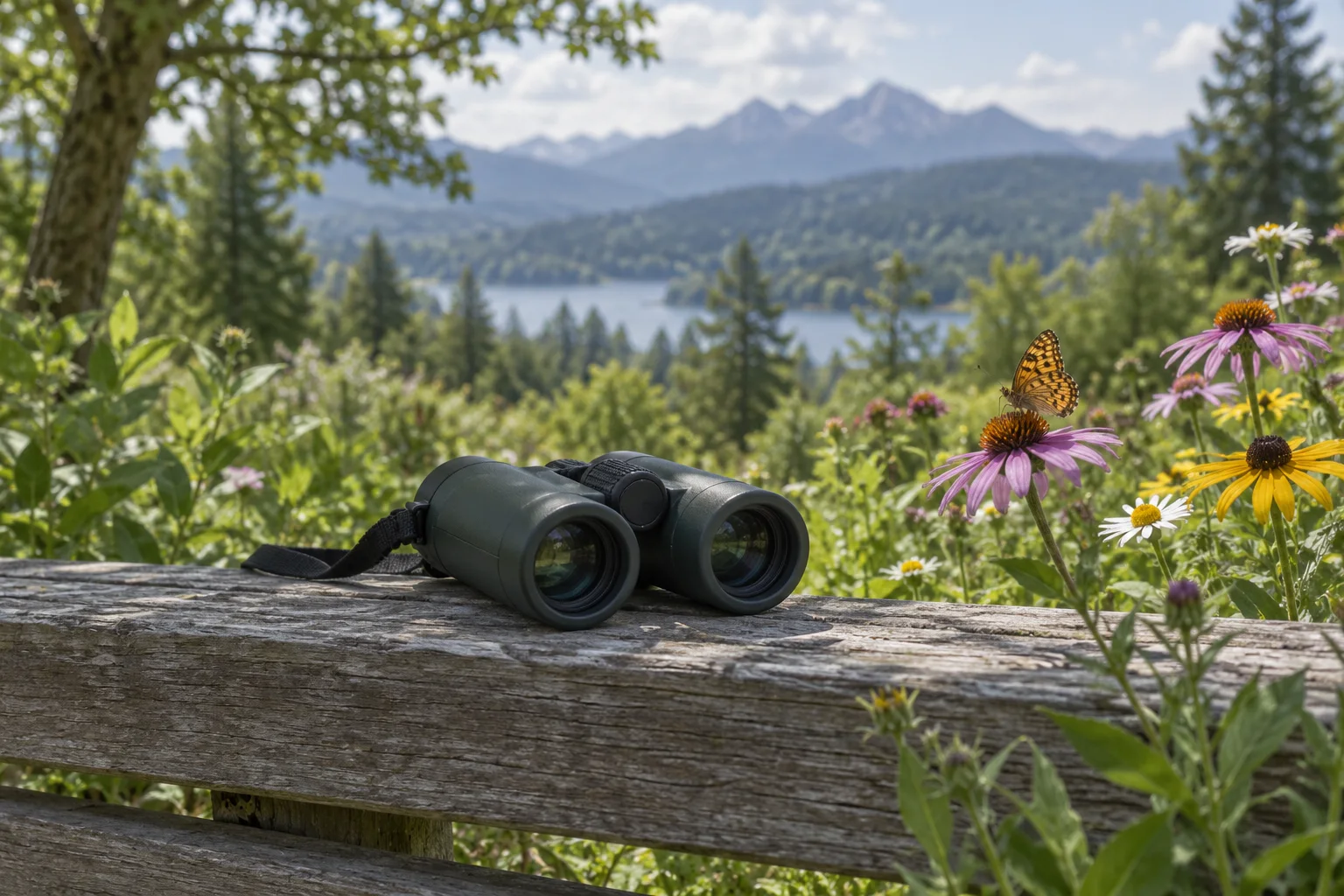
You raise your binoculars to a butterfly on a garden flower, turn the focus wheel, and still cannot make the nearby subject sharp. Before assuming the lenses need cleaning, check the instrument's close-focus specification. A binocular that works well across a valley may have a different limit when you look at something a few steps away.
Close focus is useful for buyers who want their binoculars to cover small discoveries as well as distant scenery. Here is how to read the number, relate it to your outings, and compare candidates without turning it into the only feature that matters.
What does binocular close focus mean?
Close focusing distance is the nearest distance at which a binocular can focus on a subject. Nikon describes this specification as relevant to viewing nearby plants, insects, and artwork, alongside the more familiar use of binoculars for distant subjects. Nikon's binocular specification guide
A smaller number means the instrument can focus nearer. It does not describe maximum viewing distance, and it is not another name for magnification. Read the units carefully: a distance expressed in feet can look like a much larger figure than the same distance expressed in meters.
For a simple hypothetical comparison, a subject three meters away would be within the focusing range of a binocular specified to focus down to two meters. It would be too close for one whose nearest focus is five meters. That comparison says nothing by itself about either instrument's overall image quality.
Start with where you actually stand
Make a short list of your usual viewing situations. Do you watch a garden feeder from a fixed window? Pause beside flowers on a woodland path? Look mostly across open water? Each situation creates a different distance between you and your subject.
For a garden, measure the approximate distance from your normal viewing position to the area you want to watch. You do not need to measure an insect itself. Use a fixed feature such as the flower bed, feeder pole, or fence, and write down the distance as part of your buying brief.
Keep a little flexibility in that brief. Wildlife does not stay at one measured spot, and moving your own position may be easier than finding an instrument that matches every possible encounter.
Check the exact model rather than the family name
Look for the close-focus line on the manufacturer's technical-data page. Two sizes in a product family can have different specifications.
For example, ZEISS lists a close focusing distance of 1.6 meters for its Terra ED 8x42 and 1.9 meters for its Terra ED Pocket 8x25. These are manufacturer specifications illustrating why the exact variant matters, rather than a statement about availability at our store. ZEISS Terra ED technical data
Record the model name, nearest-focus distance, and units together. If a retailer listing leaves the number out, ask for the official specification instead of inferring it from the instrument's size or a photograph.
Try the transition between near and far
Before evaluating close focus, set up the binoculars correctly for your eyes. Nikon's central-focus instructions cover eyecups, eyepiece spacing, and diopter adjustment before routine focusing with the main wheel. Follow the instructions for your own focusing system. Nikon's central-focus setup guide
Then use a stationary nearby detail and a more distant one. Focus on each in turn, noticing whether you can reach the controls comfortably. Lower the binoculars, locate the nearer subject with your eyes, and raise them again.
Write down practical observations: “easy to relocate the flower,” “focus wheel comfortable to reach,” or “requires stepping back from the feeder.” This is a useful personal fit check, not a substitute for a controlled optical test.
Avoid forcing the focusing control past its stop. If the subject will not become sharp, move farther away and check the manual and nearest-focus specification.
Remember the rest of the viewing experience
A short close-focus distance can widen the range of subjects you enjoy, but the instrument still needs to suit the rest of your day. Compare handling, carrying weight, and comfort with your usual eyewear. Decide whether nearby details are an occasional bonus or a central reason for buying.
Close focus also has uses beyond the garden. Nikon recommends a short focusing distance for museum observation, where visitors may want to inspect details without touching exhibits. Always follow the venue's rules and keep walkways clear. Nikon's museum viewing guide
Explore binoculars at Expert Binocular. If you wear glasses, our eye-relief and fit guide addresses that separate comfort check. Contact our team when you need help locating the exact manufacturer's specification.
Frequently Asked Questions
Does higher magnification mean closer focusing?
No. Magnification and nearest focusing distance are separate specifications. Check both for the exact model.
Why is a nearby flower still blurry?
It may be closer than your binocular's focusing limit. Step back and refocus after checking your setup. Persistent problems at suitable distances need further investigation.
Is the shortest close focus always the best choice?
It is most useful when nearby observation is part of your routine. Balance it with fit, handling, and the other requirements of your outings.
Can I use ordinary binoculars like a microscope?
A short focusing distance allows nearby observation within the instrument's stated range. It does not turn the binoculars into a microscope or guarantee that subjects directly in front of the lenses will focus.