
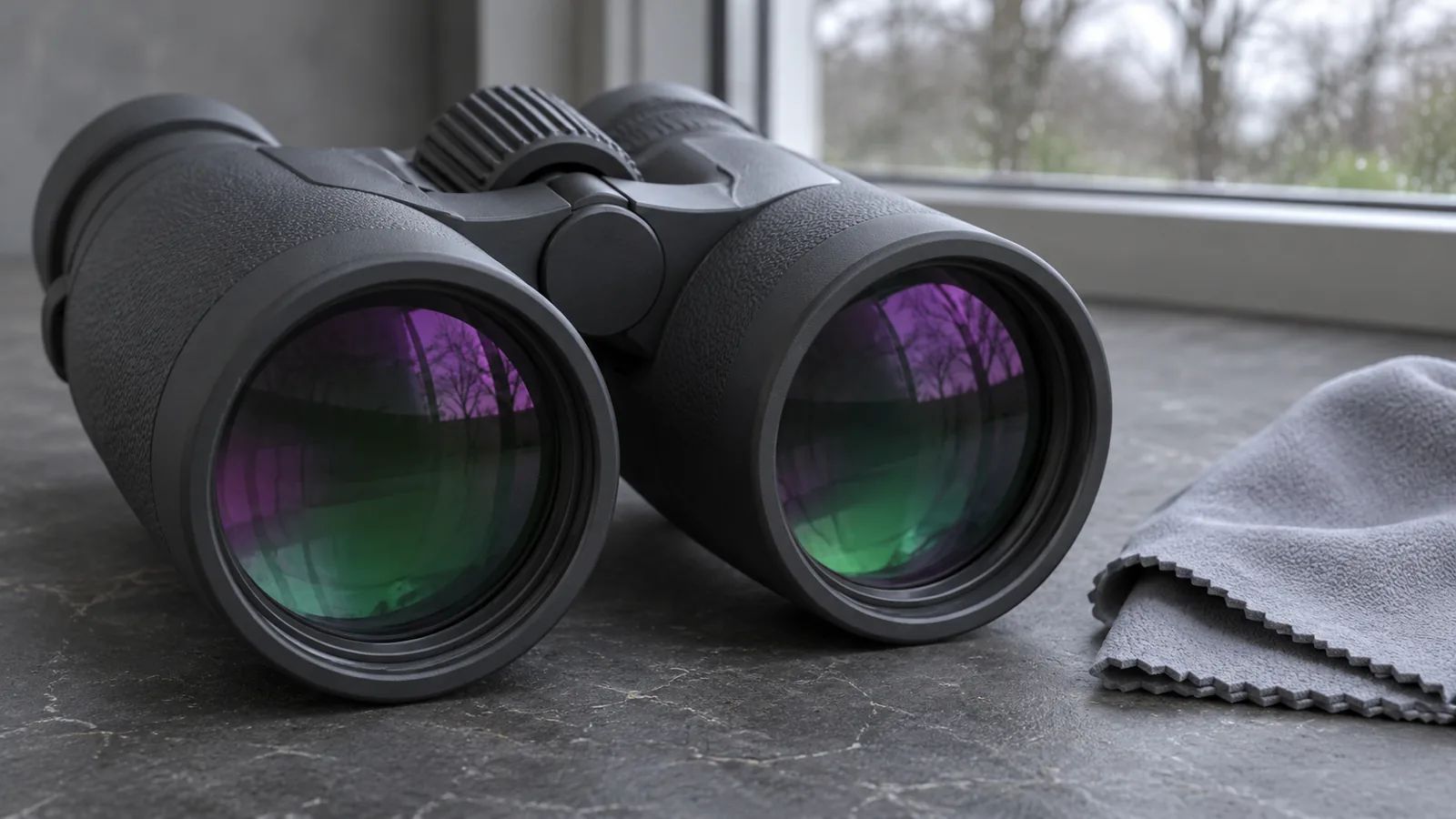
Binocular Lens Coatings: What They Do and How to Compare Them
A binocular specification sheet may mention coated, multicoated or fully multicoated optics. These terms point to treatments on optical surfaces, but they do not describe the entire viewing experience. Understanding what lens coatings are intended to do can help you ask better questions when comparing binoculars and caring for the pair you already own.
The goal of an antireflective lens coating is to reduce unwanted reflections at a glass surface. Nikon explains that light can reflect at both the front and rear surfaces of a lens; these reflections can reduce transmitted light and contribute to flare or ghosting. A coating is one part of an optical system, alongside the lenses, prisms, alignment and mechanical construction.
Why reflections matter
Light entering binoculars passes through several optical components before reaching your eyes. At a boundary between glass and air, some light can reflect instead of continuing along the intended path. Stray reflections may appear as washed-out contrast, flare or ghost images in certain lighting conditions. The effect you notice depends on the design and the scene, not simply on whether a particular word appears in a product description.
Antireflective coatings use thin layers on optical surfaces to reduce reflections over the wavelengths and angles for which they are designed. Nikon describes both single-layer and multilayer approaches and notes that multilayer coatings can reduce reflections beyond what a single layer can eliminate. This does not mean every multilayer coating is identical or that any coating eliminates every reflection.
Read labels with care
Manufacturers may use terms such as coated or multicoated to describe their products. The useful follow-up question is which surfaces are covered. A specification may refer to external lenses, selected lens surfaces, all lens air-to-glass surfaces, or both lenses and prisms. The wording differs by manufacturer and product, so read the maker's actual definition rather than assuming all labels are used identically.
For example, Nikon's published feature descriptions distinguish an optical system with multilayer coatings on transmission surfaces of all lenses and prisms. That statement applies to products carrying the relevant feature description; it should not be extended automatically to every binocular in the range. If a listing is unclear, request the manufacturer's specification for the exact model.
Lens coatings and prism coatings have different roles
A binocular contains more than objective and eyepiece lenses. Prism systems may also use coatings, including reflective coatings on a surface that needs a mirror and phase-correction coatings in a roof-prism design. Nikon describes these as distinct optical treatments. An antireflective lens coating, a prism mirror coating and a phase-correction coating should not be treated as interchangeable names for one feature.
If you want to understand the latter, see our roof-prism phase-correction guide. Look at the complete specification sheet and ask which coating is applied to which component. An abbreviated retail listing can omit those details without explaining what is present inside the instrument.
Compare the whole instrument
Coatings can influence the light that reaches your eyes, but they are not a complete quality score. Objective diameter, magnification, prism design, internal baffling and the fit of the eyepieces all matter as well. Two binoculars with similar coating claims can behave differently because their optical systems and viewing conditions differ.
When possible, compare instruments at the same location and time, using a distant detailed subject. Adjust the hinge and focus for your eyes before judging. Notice whether the image is comfortable, whether you can see the full field, and how the view changes when a bright light sits near the edge of the scene. Never look directly at the sun through binoculars: serious eye injury can occur.
Do not infer a numerical transmission percentage or rank from coating terminology alone. If a maker supplies a measured figure, check the measurement conditions, wavelength and exact model, and avoid treating values obtained by different methods as directly interchangeable.
Protect coated surfaces
Use the manufacturer's instructions for the particular binocular. Keep lens caps in place when appropriate, avoid touching optical glass, and remove loose particles using a method recommended by the maker before wiping. Never rub a dry, gritty surface or use household chemicals just because they are convenient. If the instrument has a persistent mark or damaged surface, consult the manufacturer or an authorized service provider.
Our binocular lens cleaning guide covers a gentle routine, but the instructions supplied with your instrument take precedence. A coating may be durable enough for normal use while still being vulnerable to abrasion or an unsuitable cleaning solution.
Questions to ask before choosing
Ask which lens and prism surfaces are treated, what the manufacturer means by its coating label, and how to clean those surfaces. Then compare ergonomics, optical specifications and the support available for the exact product. A clear explanation of the full optical system is more useful than a coating label considered on its own.
Sources: Nikon's explanation of lens coatings, Nikon's feature descriptions, and Nikon's roof-prism coating guide.
Cover: AI-generated editorial illustration of generic binoculars.