Choose between Nikon PROSTAFF P7 8x30 and 8x42 by comparing carrying comfort, viewing fit, and your usual observation conditions. Both have 8x magnification, so this decision concerns two sizes within one family rather than a choice between magnification levels.
The compact model is lighter and has a wider published field of view; the full-size model offers a larger exit pupil and longer published eye relief. Neither combination establishes a universal winner. This is a specification-based comparison, not a hands-on optical test.
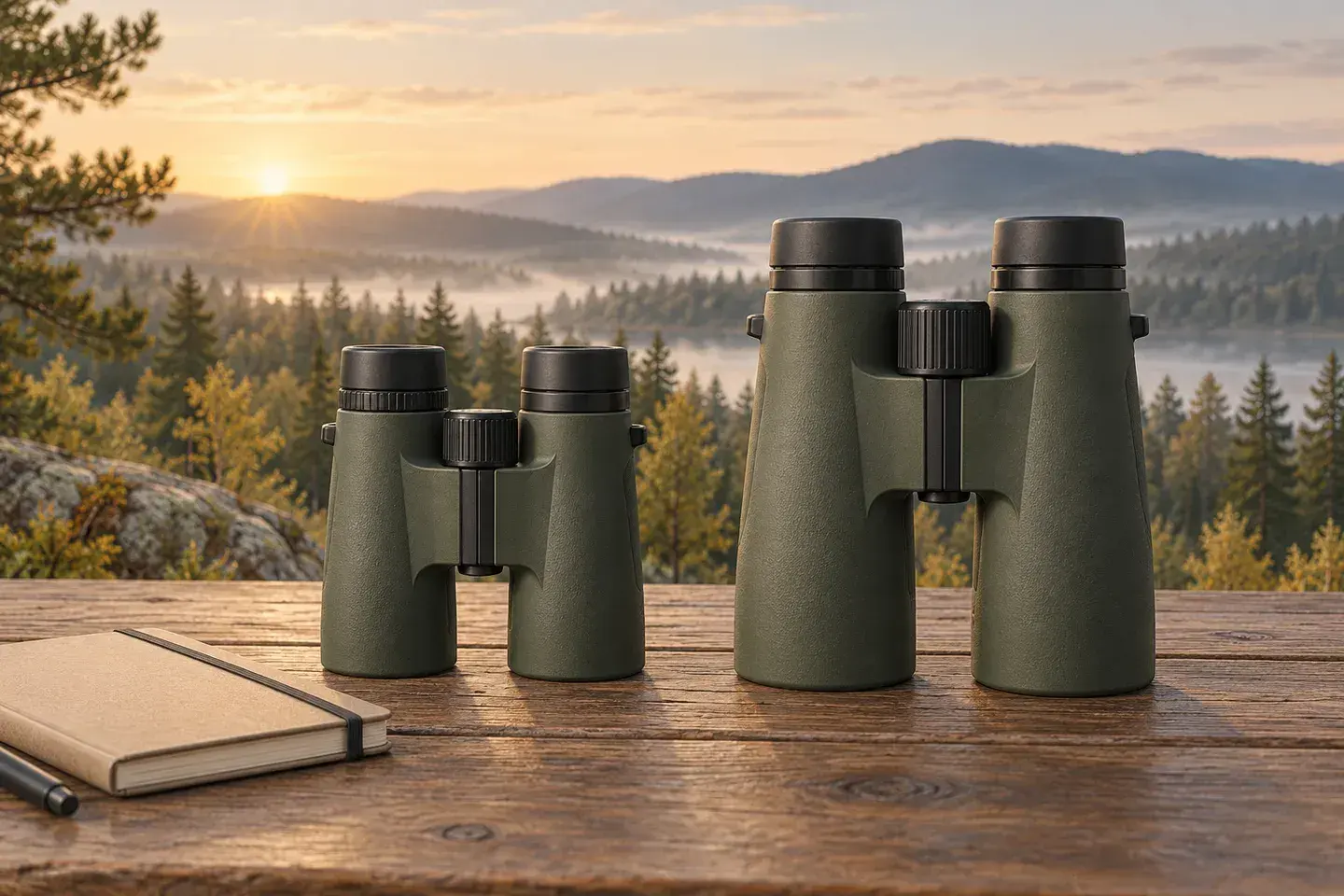
Cover: AI-generated editorial illustration of two generic roof-prism binocular sizes. It does not depict either Nikon model or reproduce their measured proportions.
Check the exact model name in any quotation. Specifications for a 10x version, an older PROSTAFF 7, or another Nikon family should not be substituted into this table.
Start with the outing you actually take
Describe a normal trip in a single sentence: for example, a daytime walk with repeated stops, a fixed viewpoint near the car, or an early-morning observation session. Include how long you carry the binoculars and whether you wear glasses.
That description supplies priorities before the numbers compete for attention. If the instrument spends most of the outing in a bag because it is inconvenient to carry, a specification advantage may contribute little to your routine. Conversely, a compact format is not automatically a better choice if you cannot obtain a comfortable full view through it.
Write two essential requirements and two preferences. Keep them separate. An essential fit requirement should not disappear simply because another model is lighter or appears more impressive on paper.
Weigh the complete carrying arrangement
The published instrument weights differ by 105 grams, or about 3.7 ounces. That is subtraction from the specification table, not a measurement of a supplied kit. A strap, case, caps, and other accessories change what you actually carry.
If possible, handle each model with the carrying arrangement you intend to use. Note how you retrieve it, whether the strap remains comfortable, and how easily you can return it to the bag. Do not infer long-term comfort from a quick lift at a counter.
A practical trial note might say, “easy to retrieve with this bag,” or “need to adjust the strap before comparing again.” It should record your observation rather than become a general claim about every observer.
Compare viewing width without assuming bigger objectives win
In this particular pair, the smaller model has the wider published real field of view. Objective diameter alone does not tell you how broad a scene a binocular presents.
During an allowed demonstration, compare the same stationary scene from the same place. Look for whether you can comfortably see the complete field, find an object again after lowering the binoculars, and operate the focus control without changing your grip awkwardly.
Those checks help you assess use; they do not measure resolution or establish an optical-quality ranking. A field-width figure and your ability to use the whole field are related questions that should be recorded separately.
For more background, the field-of-view guide explains how to keep real angle, apparent angle, and view width in their proper columns.
Put exit pupil in the context of light
Nikon's selection guide explains exit pupil as objective diameter divided by magnification. It also connects larger objectives with greater light-gathering capability and a larger instrument.
Here, 30 divided by 8 equals 3.75 mm, rounded in the published table to 3.8 mm. For the other model, 42 divided by 8 equals 5.25 mm, published as 5.3 mm. These are arithmetic checks, not brightness measurements.
Do not convert the ratio between those numbers into a promise about the view every person will experience. Include the ambient light, your viewing fit, and the intended use in the comparison. Our exit-pupil explanation covers why that specification needs context.
Check eye relief with your actual glasses
Published eye relief is a useful reason to examine fit more carefully. It cannot describe every eyeglass frame, facial shape, or preferred eyecup position.
Use your normal glasses during a demonstration if that is how you will observe. Follow the model's instructions for the eyecups and focusing setup. Check whether you obtain a comfortable complete image without constantly searching for eye position.
Keep the comparison consistent: the same glasses, the same scene, and sufficient time to adjust each model correctly. If one looks uncomfortable initially, verify the setup before deciding the specifications alone explain the result. The glasses-use guide offers a way to organize those checks.
Use a decision card instead of a total score
Give each model its own row under these questions:
Does the complete carrying arrangement fit my outing?
Can I obtain the full view with my normal glasses or eyecup setup?
Does the published field width suit the way I find subjects?
Have I considered my actual light conditions rather than one number?
Are the exact model, supplied items, and purchase terms confirmed?
The 8x30 deserves attention when compact carrying and a broad published field match your priorities. The 8x42 deserves attention when its exit-pupil and eye-relief specifications fit the questions you need to resolve. Make the final choice from the complete use case and a properly adjusted demonstration where possible.
Frequently asked questions
Does the 8x42 magnify more than the 8x30?
No. Both models in this comparison have 8x magnification. The second number identifies objective diameter in millimeters.
Which one has the wider field of view?
For these exact models, Nikon publishes a wider real field for the P7 8x30. Do not assume the same relationship applies to all binocular families.
Is the smaller one always more comfortable?
No. Carrying weight is one consideration, while grip and viewing fit are separate. Assess the complete arrangement you expect to use.
Does the larger exit pupil guarantee a better daytime view?
It does not establish a universal result. Lighting, viewing fit, and other optical characteristics also matter. A calculated diameter is not a hands-on brightness test.
Which should I choose if I wear glasses?
Use the published eye-relief difference as a prompt to test both with your actual glasses. Choose only after checking the full view with the appropriate eyecup setup.
Are these tested performance results?
No. The table contains manufacturer specifications, and the calculations are labeled arithmetic examples. This guide does not claim independent laboratory or field testing.